

An Integrated Library System (ILS) also known as a Library Management System (LMS), is software designed to streamline library operations for example:
- Cataloging library materials e.g. books, DVDs, audiobooks;
- Keeping track of who has borrowed what and when it’s due back;
- Handling library purchases and acquisitions;
- Managing library memberships and administrative accounts.
Benefits of a Integrated Library System
There are many benefits to deploying an ILS, including:
- Efficiency: Automating a lot of administrative tasks, which frees up library staff time to focus on helping and engaging with patrons and working on other services.
- Accuracy: Reducing the risk of errors in cataloging and circulation processes.
- Accessibility: Allowing patrons to search the library catalog, renew materials, and place holds online.
- Reporting: Providing library staff with statistics and data about how the library is being used, which can help them improve services and collections.
Types of Integrated Library System
ILS’s can be broadly classified based on deployment model and target user base. Here’s a rundown of some common types:
By Deployment Model:
- On-Premise: Installed and runs on the library’s own servers. It offers more control but requires IT infrastructure and maintenance.
- Cloud-Based (SaaS): Hosted by a vendor and accessed over the internet. It’s typically easier to set up and maintain, with lower upfront costs.
- Open-Source: Freely available ILS with the source code accessible for modification. They require technical expertise for setup and maintenance but offer flexibility and lower costs.
By Target User Base:
- Public Library: Focusing on public access catalogs, circulation of physical materials, and user self-service options.
- Academic Library: Will include features like integration with research databases and management of electronic theses and dissertations.
- School Library: Emphasizes ease of use, age-appropriate interfaces, and integration with curriculum resources.
- Special Library: Focus on a specific subject area, such as law, medicine, or business. They have collections of materials that are relevant to their specific field and serve a specialized clientele.
Core features of a Integrated Library System
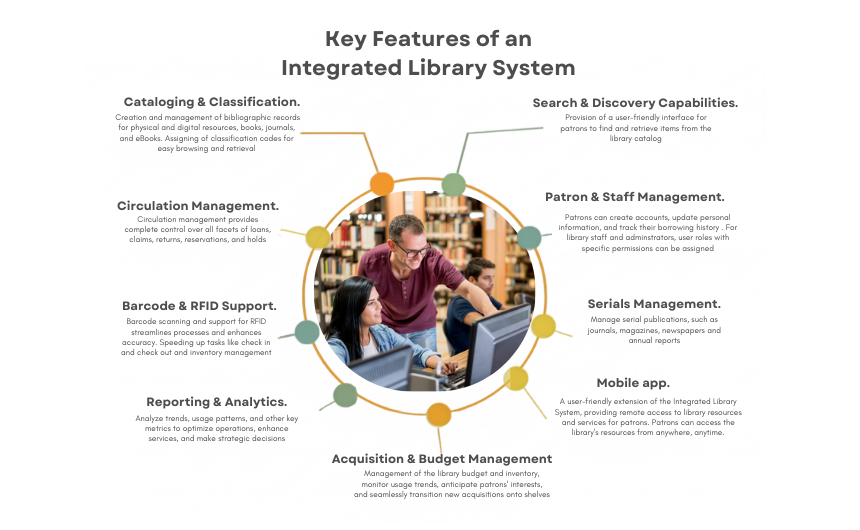
An Integrated Library System comes with a variety of features to handle different aspects of a library’s operation. Here’s a breakdown of some core functionalities:
1. Cataloging and Classification
Create and manage bibliographic records for physical and digital resources, books, journals, eBooks, etc. Integrated Library Systems should efficiently manage and organise library resources with customisable cataloging templates, batch processing and support for any physical or digital format.
To assign classification codes for easy browsing and retrieval, ensuring compliance with industry standards such as Resource Description and Access (RDA) and MARC21. Complying with the industry standards makes import and export of bibliographic records straightforward.
2. Search capabilities
It’s essential that a Integrated Library System provides a user-friendly interface for patrons to find and retrieve items from the library catalog (via the WebOPAC) by title, author, subject, keyword, etc. Ideally the search functionality will have state-of-the-art techniques to identify the closest match terms, ensuring search is both intuitive and efficient.
3. Circulation Management
Having comprehensive circulation management provides complete control over all facets of loans, claims, returns, reservations, and holds, helping maximize inventory efficiency so staff can carry out their tasks with ease and minimal hassle.
An ILS with Inter Library Loan (ILL) capabilities allows users to request materials from other libraries, vastly increasing the pool of information available to them. This is especially important for academic libraries or those in smaller communities. ILL capabilities foster a collaborative network of resources, ultimately benefiting library patrons and furthering their research and learning goals.
4. Patron and Staff Management
Patrons should be able to create accounts, update personal information, and track their borrowing history – this should be managed in a tailored patron portal making it easy for patrons to interact with the library. The ILS should be able to send automated notifications for holds, overdue loans, and system messages.
The ILS must be able to assign different user roles for library staff and administrators, with specific permissions. This ensures only authorized users can access certain functions, keeping library resources secure and organized.
5. Acquisition and Budget Management
Manage your library’s budget and entire inventory with ease, monitor usage trends, anticipate patrons’ interests, and seamlessly transition new acquisitions onto shelves through efficient workflows.
6. Serials Management
Efficiently manage serial publications, such as journals, magazines, newspapers and annual reports with predictive list generation, claiming workflows, binding options, and precise routing list management.
7. Reporting and Analytics
Analyse trends, usage patterns, and other key metrics to optimize operations, enhance services, and make strategic decisions that positively impact patrons and overall effectiveness.
8. Barcode and RFID (Radio Frequency Identification) Support
Barcode scanning is a crucial feature for a Integrated Library System as it streamlines processes and enhances accuracy. Scanning eliminates manual data entry, reducing errors and speeding up tasks like check-in, check-out, and inventory management. This translates to shorter waiting times for patrons and frees up library staffs time for other duties.
RFID support within a Integrated Library System offers significant advantages. Compared to barcodes, RFID drastically improves checkout speed by allowing librarians to scan multiple items at once, additionally, self-service kiosks become a possibility, allowing patrons to check out materials independently.
9. Mobile app
For convenience the Integrated Library System should have a mobile version for its patrons to use. It essentially acts as a user-friendly extension of the ILS, providing remote access to library resources and services for patrons. With an app, patrons can access the library’s resources from anywhere, anytime. They can search for books, renew borrowed items, place holds, and even pay fines without having to visit the physical library. Patrons can receive notifications and alerts through the app about due dates, availability of reserved items, library events, and promotions. This helps in keeping users informed and engaged with the library’s activities.
About Libero
Libero, by Knosys, is your all-in-one Integrated Library System for elevating library success and delivering the best experiences for both patrons and staff.
Developed by librarians in collaboration with industry experts, Libero is the secure cloud-based solution enabling accessibility and seamless interaction across all your devices.
Transform your library today! contact us today and see how we can elevate your library experience