

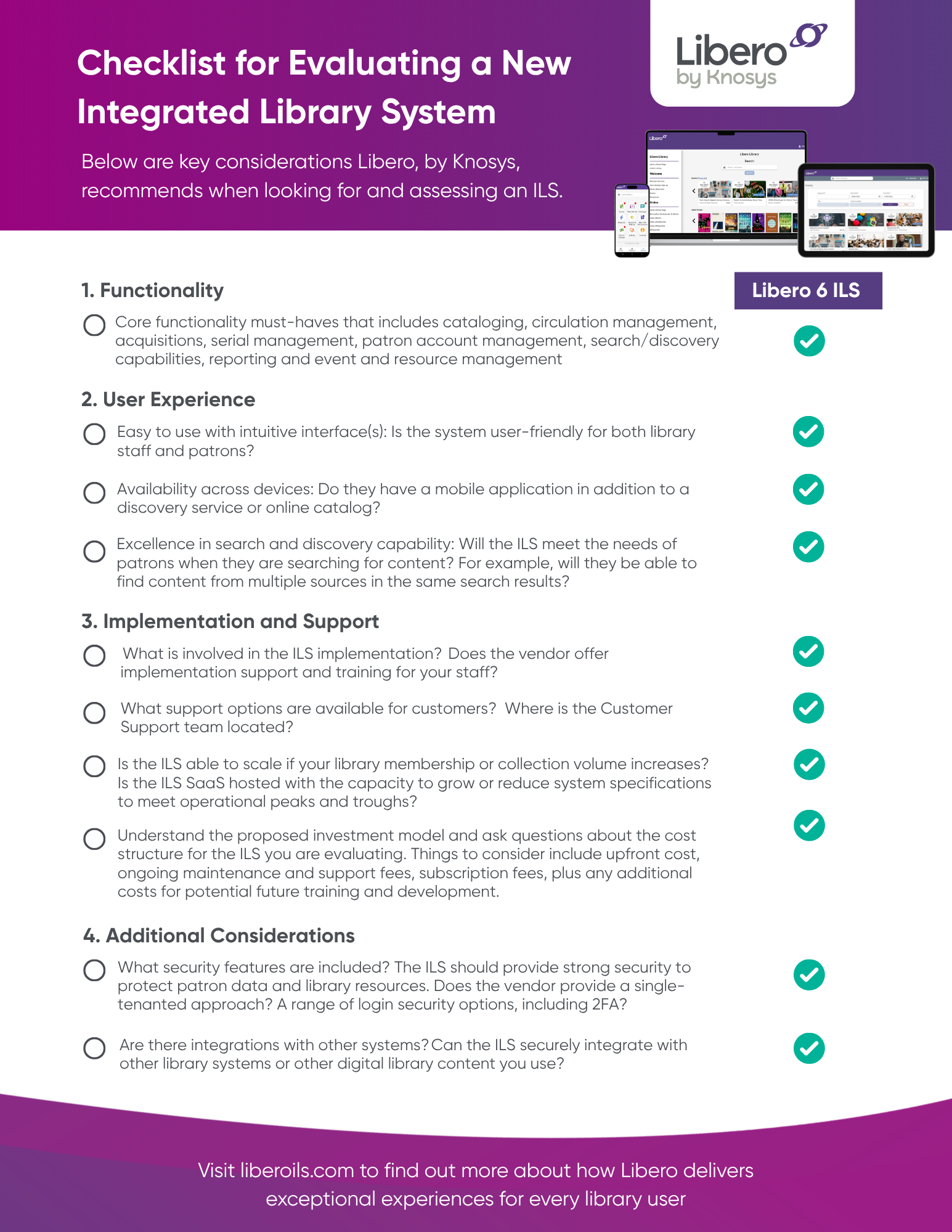
An Integrated Library System (ILS) is the software platform libraries rely on to manage cataloging, circulation, patron accounts, and resource discovery in one connected system. Choosing the right ILS is a significant decision that shapes staff workflows and patron experience for years, so it is worth evaluating carefully before committing. Beyond individual features, the strongest systems function as a single accountable platform rather than a set of separately licensed tools. Below is a comprehensive checklist to help you evaluate and select the best ILS for your library.
In short: a thorough ILS evaluation weighs four primary areas — core functionality, user experience for staff and patrons, implementation and support, and reliability and security. Below is a comprehensive checklist covering each of these areas in detail.
What core functionality should an ILS include?
Ensure the ILS includes essential features such as:
- Cataloging to organize and maintain your collection.
- Circulation Management to manage borrowing and returns.
- Acquisitions & Serial Management for handling new materials and subscriptions.
- Patron Account Management for easy access and control.
- Search & Discovery tools to help users find resources quickly.
- Reporting & Analytics for data-driven decision-making.
- Event & Resource Management for scheduling library events and booking rooms or equipment.
Cataloging, circulation, patron records, acquisitions, and branch operations belong on a single operational core. Confirm whether patron-facing extras such as events, room booking, and mobile access are an integrated part of that same platform, or a separately licensed module.
What are the essential factors for a top-tier ILS user experience?
A great ILS should prioritize usability and accessibility:
- Easy to use with intuitive interface(s): Is the system user-friendly for both library staff and patrons? Library patrons should be able to quickly grasp and find what they need, borrow materials, and manage their accounts without extensive training.
- Multi-device access: Does the vendor have a mobile offering in addition to their online catalog? A library app will complement your main ILS by offering the same functionality accessible on a mobile device.
- Excellence in search and discovery capability: Will the ILS meet the needs of patrons when they are searching for content? For example, will they be able to find content from multiple sources in the same search results? Will the system recommend items for patrons to explore further?
- Continuity between physical and digital collections: Does the ILS carry staff-curated displays, local history, and heritage collections into the digital interface patrons use, so curation work extends beyond the building?
How will the ILS be implemented and supported?
Before committing to purchasing an ILS, understand the vendor’s approach to:
- Implementation process: What does the implementation involve, and what is the expected timeline? Does the vendor provide onboarding, data migration, and staff training as part of the process?
- What support options are available? What channels and response times are offered?
- Cost structure: Understand the proposed investment model and ask questions about the cost structure for the ILS you are evaluating. Things to consider include upfront cost, ongoing maintenance fees, subscription fees, plus any additional costs for potential future training and development. Ask whether pricing is a single flat-rate license covering the backend and the patron-facing front end, or whether separate modules, integrations, and renewal add-ons are billed on top.
Is the ILS reliable and secure?
On-premise servers carry a growing maintenance and security burden compared with cloud-hosted alternatives. A SaaS (Software as a Service) ILS, hosted and maintained by the vendor, keeps data accessible from anywhere without requiring in-house server upkeep.
- Scalability: Can the ILS grow with your library’s membership and collection?
- Data Security: What security features are included? The ILS should provide security to protect patron data and library resources. Does the vendor provide a single-tenanted approach on cloud-native infrastructure built to handle multi-site data?
- Integrations: Can the ILS securely integrate with other library systems or digital content platforms you use? Does it support standard protocols such as OAI-PMH (Open Archives Initiative Protocol for Metadata Harvesting) for sharing data across platforms?
- Governance reporting: Does the ILS produce reporting suited to budget hearings and other municipal governance conversations, not only to internal operational review?
What else should you check before signing?
- Vendor references: Ask for references from current and past clients with similar library needs.
- Independent research: Look into the vendor’s product roadmap and investment in new features and read independent reviews and comparisons of different ILS options.
- Stakeholder alignment: Confirm that the person accountable for community outcomes and budget, and the person responsible for daily workflows and data integrity, both evaluate the shortlist against their own priorities before a final decision is made.
How do you make the final decision?
This checklist is designed to support an informed decision-making process when selecting an integrated library system that fits your library’s specific requirements. Weighing each of these factors, rather than focusing on any single feature, tends to produce the best long-term fit. Libraries often find themselves choosing between consolidated legacy platforms carrying years of technical debt and entry-level tools that cannot scale past a single branch. A system able to replace core ILS functions across a multi-branch estate, with room to add patron-facing tools, generally sits between those two extremes.
To learn how Libero brings core ILS operations and patron-facing tools together as a single accountable platform, contact us or request a demo.